




PRACTICAL DAILY TRAINING FOR HOLINESS
Stop striving for holiness in isolation. We all know what it means to be virtuous, but few of us know how to actually get there. Most spiritual books explain the theology of virtue, but leave you at the altar of good intentions, wondering how to bridge the gap between your desire for sanctity and your daily reality.
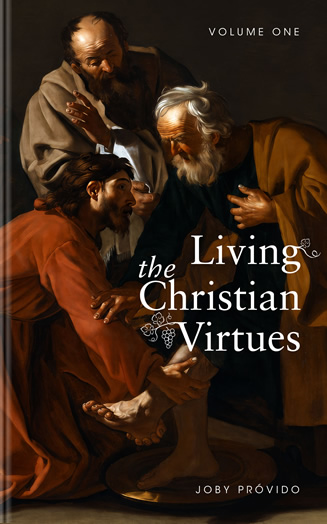
Living the Christian Virtues bridges that gap. By providing a practical, grace-filled roadmap, this book helps you transform good intentions into stable daily habits.
THE BOOK



A Step-by-Step Blueprint for Heroic Virtue
In this step-by-step guide, you will discover:
- The 3-Level Progression System: A clear journey mapping your growth through 32 core virtues. Move step-by-step from foundational daily discipline (Level 1: Receptive Readiness), to active interior formation (Level 2: Active Submission/Formation), and ultimately to the heroic surrenders of mature sanctity (Level 3: Integrated Integrity).
- Modern-Day Examples: Discover how these ancient virtues are lived out today. From a parent navigating family discipline with prudence, to a professional facing ethical dilemmas, to a parishioner choosing forgiveness over resentment—every virtue includes relatable, modern contexts.
- The Power of Habit Triggers: Concrete, numbered steps that teach you how to attach short prayers, silent pauses, and moral choices directly to your everyday routine.
Track Your Growth: The Companion Journal
When used alongside the companion Virtue Journal (sold separately), you can visually track your daily growth, identify hidden spiritual blind spots, and build tailored action plans to advance through every stage of virtue.
The journal operationalizes the book’s 3-Level framework into a structured daily tracking page. Begin your morning with a clear commitment, identify your behavioral triggers, and end the day with an evening review to discern where you cooperated with grace and where you resisted.
READ THE WAY YOU WANT
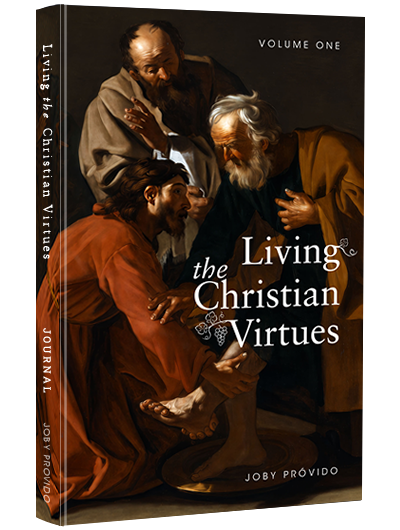
| Paperback | ||
|---|---|---|
| ISBN 13 | 979-8173594754 | |
| ASIN | B0HJNFD7HV | |
| Publisher | Kindlings Press | |
| Publication Date | September 13, 2026 | |
| Language | English (American) | |
| Size | 6" x 9" | |
| Pages | 282 cream | |
| Cover | Full color, matte-finished | |
| BUY ON AMAZON | ||

In the Philippines?
Order the books locally and get them faster.
VOLUME 1 BUNDLE, ONLY ₱1495.00
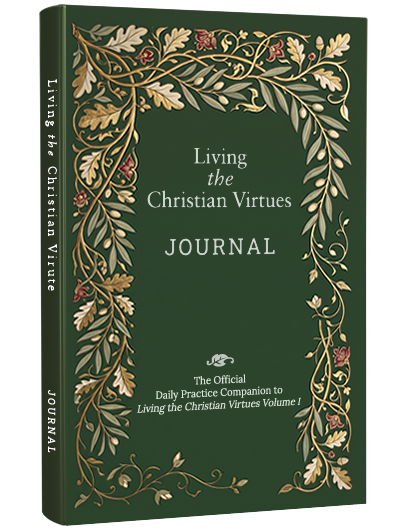
| Journal | ||
|---|---|---|
| ISBN 13 | Not Applicable | |
| ASIN | B0HJNCF6BK | |
| Publisher | Kindlings Press | |
| Publication Date | September 13, 2026 | |
| Language | English (American) | |
| Size | 6" x 9" | |
| Pages | 200 cream | |
| Cover | Full color, matte-finished | |
| BUY ON AMAZON | ||
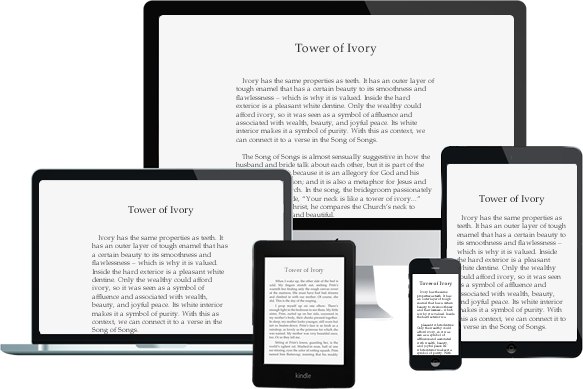
| Kindle Ebook by Amazon | |
|---|---|
| File Size | 610 KB |
| ASIN | B0HJLYRFH3 |
| Publisher | Kindlings Press |
| Publication Date | September 13, 2026 |
| Print Length | 284 pages |
| Language | English (American) |
| Page Flip | Enabled |
| X-ray | Not Enabled |
| Word Wise | Enabled |
| Enhanced Typesetting | Enabled |
| Sticky Notes | On Kindle Scribe |
|
Download the free Kindle App and start reading today. 


|
|
| BUY ON AMAZON | |
Now an AUDIO BOOK you can listen to!
Listen as you drive, workout, or bask under the sun.Excerpts
Introduction
Our goal in this life is to become saints! IN the language of Christianity, that means we strive to be one with God in this life so we continue to live that way for all eternity. This call to inherit and live the divine life is so paramount that those who wrote the Catechism attentively put it as the first paragraph
A life with God is not an ordinary one for God is above our nature – he is supernatural. He shares his divine life with us, and we must conform to it so we can partake in that supernatural life. If we use SCUBA gear to live like fish in water, and if we use a plane to live like birds in the air, so must we use an instrument to live the life of God that is so different from ours.
Sanctifying Grace is what allows us to share in the Trinitarian life. It is what makes us saints, which comes from the Latin “sanctus” that means, “holy.” So, it isn’t what we know or do that makes us saintly or holy, but grace. While grace makes us holy, Saint James reminds us that faith without good works is dead. We reconcile these two ideas when we recognize that we must cooperate with God’s grace so that it animates us to do good works. Our actions, therefore, are the “evidence” that we are cooperating with grace. This is why the Church looks for Heroic Virtues in a candidate for sainthood.
Simply put, a virtue is a good habit or disposition. Virtues, however, don’t just happen; we must spend time to develop them the way we acquire a new skill. The initial notes of a beginner playing the violin may be jarring, perhaps even painful to the ear. But, with the struggle of constant practice, a budding violinist has the potential to become a virtuoso and make an audience weep in the splendor of his or her music.
Heroic Virtue is the result of a series of battles wherein we overcome our fallen human nature to rise up to the occasion, cooperate with God’s grace, and rise from the slumber of a lifeless existence without grace. We are spiritual warriors who struggle against our weaknesses as well as the trials that this world places in our way. Each battle we win makes us grow in virtue so that in the end someone who has gained heroic virtue no longer has to make an effort because it becomes so much a part of the person that it has become second nature. That is what “heroic virtue” means.
Another way of looking at it is this: heroic virtues are the fruits of cooperating with God’s grace. These instinctive virtues are what the Church looks for in a person who is being considered for canonization.
While the result of cooperating with grace is habitual good works, it may work the other way around too. An external act is motivated by the will or intent of a person. In the Summa Theologiae, St. Thomas Aquinas says that an external act does not add any goodness or malice to the intent. While this is true, constantly doing something can, however, condition the will to act as such.
The Church, for example, constantly asks us to pray, give alms, and fast especially during Lent. They are outward expressions of interior conversion. In other words, these are done in the hope of reorienting the interior life to change for the better. This is because moral virtues are acquired by human effort. They are the fruit and seed of morally good acts; they dispose all the powers of the human being for communion with divine love.
In a cherished second-century manuscript entitled The Shepherd of Hermas, fasting is said to deny oneself in order to become more generous to those who are hungry. The external action may lead to a change in disposition. The operative word is “may,” for it is only through one’s will that a change can be made. But, isn’t it better to have a catalyst than nothing at all? Aren’t our chances at interior change improved if there is an act that prompts us to do so?
Faith
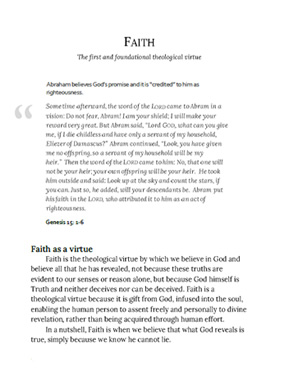
The first and foundational theological virtueAbraham believes God’s promise and it is “credited” to him as righteousness.
" Some time afterward, the word of the LORD came to Abram in a vision: Do not fear, Abram! I am your shield; I will make your reward very great. But Abram said, “Lord GOD, what can you give me, if I die childless and have only a servant of my household, Eliezer of Damascus?” Abram continued, “Look, you have given me no offspring, so a servant of my household will be my heir.” Then the word of the LORD came to him: No, that one will not be your heir; your own offspring will be your heir. He took him outside and said: Look up at the sky and count the stars, if you can. Just so, he added, will your descendants be. Abram put his faith in the LORD, who attributed it to him as an act of righteousness.
Genesis 15: 1-6
Faith as a Virtue
Faith is the theological virtue by which we believe in God and believe all that he has revealed, not because these truths are evident to our senses or reason alone, but because God himself is Truth and neither deceives nor can be deceived. Faith is a theological virtue because it is gift from God, infused into the soul, enabling the human person to assent freely and personally to divine revelation, rather than being acquired through human effort.
In a nutshell, Faith is when we believe that what God reveals is true, simply because we know he cannot lie.
Sacred Scripture presents faith first and foremost as trustful adherence to God. The Letter to the Hebrews gives the Church a classic description: “Faith is the realization of what is hoped for and evidence of things not seen.” Faith grasps realities that surpass human sight and anchors the soul in God’s promises.
Saint Paul emphasizes its relational character: “For by grace you have been saved through faith, and this is not from you; it is the gift of God”.
The Catechism of the Catholic Church teaches:
"
Faith is a personal adherence of the whole man to God who reveals himself. It involves an assent of the intellect and will to the self-revelation God has made through his deeds and words.
CCC § 176
And again:
" Faith is a gift of God, a supernatural virtue infused by him.
CCC § 153
Faith, therefore, is not merely intellectual agreement with religious ideas, nor is it a vague optimism or emotional confidence.
It isn’t blind belief without reason, but recognizing that our intellect is finite, and must eventually bow before what an infinite God says. This is where acceptance of doctrinal “mysteries” come in. We believe that in the liturgical celebration of the Mass, the bread turns to the body of Christ because he says, “this is my body,” and that wine turns to his blood because he says, “this is my blood,” and to “do this in remembrance of me.”
It is a theological virtue because it has God as its direct object and origin. It enables the believer to enter into a living relationship with the Triune God and to receive His saving truth.
Fruits and Promises of Faith
The fruits of faith are both interior and practical. Spiritually, faith brings communion with God, peace of heart, and confidence in divine providence. Morally, it shapes conscience and strengthens perseverance in good. Practically, it gives meaning to suffering and steadiness in uncertainty.
Jesus repeatedly connects faith with freedom and healing: “Your faith has saved you”. Faith liberates the soul from fear, relativism, and despair by rooting life in God’s truth. It leads to holiness by conforming the believer’s mind and heart to Christ, who is “the way and the truth and the life”.
Vices and Dispositions Opposed to Faith
Opposed to faith are unbelief, doubt, presumption, and indifference. Unbelief rejects revealed truth; doubt hesitates or withholds assent; presumption trusts in self rather than God; indifference treats divine truth as irrelevant.
The Catechism teaches:
" Voluntary doubt about the faith disregards or refuses to hold as true what God has revealed.
CCC § 2088
These dispositions deform the soul by weakening trust in God and fragmenting the moral life. When faith erodes, prayer becomes sporadic, obedience burdensome, and charity fragile. Growth in holiness stalls because the soul no longer rests securely on God.
Examples of Faith
The Gospels consistently present Jesus calling forth faith and praising it. A striking example is the healing of the centurion’s servant. The centurion declares, “Only say the word and my servant will be healed” . Jesus responds with astonishment: “Amen, I say to you, in no one in Israel have I found such faith”. This faith recognizes Christ’s authority and trusts entirely in His word.
Here faith is humble, confident, and obedient. It does not demand signs but rests in who Christ is.
The Blessed Virgin Mary stands as the preeminent model of faith. At the Annunciation, she assents to God’s plan without full understanding: “May it be done to me according to your word”. Elizabeth proclaims her blessed precisely for this reason: “Blessed are you who believed that what was spoken to you by the Lord would be fulfilled”.
Among the saints, Saint Abraham — whom Scripture calls “our father in faith” — believed God’s promise against all human expectation. He entrusted his future entirely to God, becoming a model for all believers.
Faith in Everyday Modern Life
Faith is lived today in concrete and often hidden ways. Here are some examples:
First, a parent who brings a child to Mass and prayer despite exhaustion demonstrates faith by trusting that God’s grace works through ordinary fidelity. The action flows from belief in God’s promises rather than visible results.
Second, a professional who refuses unethical practices, even at personal cost, lives faith by placing trust in God’s providence rather than immediate security.
Third, a believer who remains faithful to prayer and the sacraments during spiritual dryness practices faith as perseverance without consolation, trusting God’s presence beyond feelings.
In each case, faith is not theoretical but embodied trust that shapes decisions.
Practical Ways to Cultivate Faith
Faith grows through cooperation with grace. Theologically, it is nourished by the sacraments, especially the Eucharist, which strengthens communion with Christ. Prayer — especially listening prayer rooted in Scripture — allows faith to mature through encounter with God.
Human formation also plays a role. Study of the faith forms the intellect, discipline strengthens consistency, and reason helps integrate belief with daily life. The Catechism affirms: “Faith seeks understanding”.
Moral effort is necessary but never sufficient on its own. Choosing fidelity, embracing sacrifice, and persevering in obedience dispose the soul to receive greater grace. Growth in faith is not self-generated improvement but a sustained response to God’s initiative.
Faith becomes stable through repeated, concrete acts that train the soul to trust God habitually. Here’s a plan:
Level 1: Receptive Begging (Steps 1-3): Acknowledging that faith is a gift; we start by simply asking for it and setting aside time to hear God's word.
Level 2: Intellectual Alignment (Steps 4-6): Actively submitting the mind to the Creed and Church teachings to ground faith in objective truth .
Level 3: Integrated Integrity (Steps 7-11): Integrated Integrity (Steps 7-11): Transforming belief into a way of life through moral choices, public witness, and surrender during trials .
Step 1. Ask God explicitly for an increase of faith
Faith grows when it is humbly requested. Scripture records the apostles’ simple prayer: “Increase our faith”. Asking for faith acknowledges its supernatural origin and expresses trust in God’s generosity.
This prayer forms humility and openness. It reminds the believer that faith is sustained by grace, not by effort alone. Regularly asking for faith keeps the soul receptive and dependent on God.
Attach this prayer to a daily trigger (upon waking, before work, or after Communion) so it becomes habitual rather than occasional.
Step 2. Set aside daily time for prayer, however brief
Faith cannot remain alive without prayer. Daily prayer need not be long or elaborate, but it must be faithful. Setting aside a consistent time in the morning or evening to acknowledge God’s presence is an essential act of trust.
In prayer, the believer places life before God as it truly is: hopes, fears, gratitude, struggles. This repeated turning toward God forms the habit of reliance. Faith grows because prayer continually reaffirms that God is real, attentive, and involved. Even brief daily prayer teaches the soul that it does not stand alone.
Fix both a time and a place, even if the prayer lasts only two minutes.
Step 3. Read Sacred Scripture regularly, especially the Gospels
Faith is nourished by hearing God speak. Regular reading of Sacred Scripture, particularly the Gospels, allows the believer to encounter Christ directly. This need not involve extensive study; a short passage read prayerfully is sufficient.
Through Scripture, faith is informed and purified. God’s promises, commands, and actions shape the believer’s understanding of who God is and how He works. Regular exposure to Scripture guards faith against distortion and forgetfulness. Over time, Scripture becomes a familiar voice that steadies faith amid uncertainty.
Read one Gospel paragraph daily rather than aiming for quantity.
Form the habit: Father Mike Schmitz has a Bible in a Year podcast on Spotify. Listen to it daily.
HIGHLIGHTS
THE AUTHOR
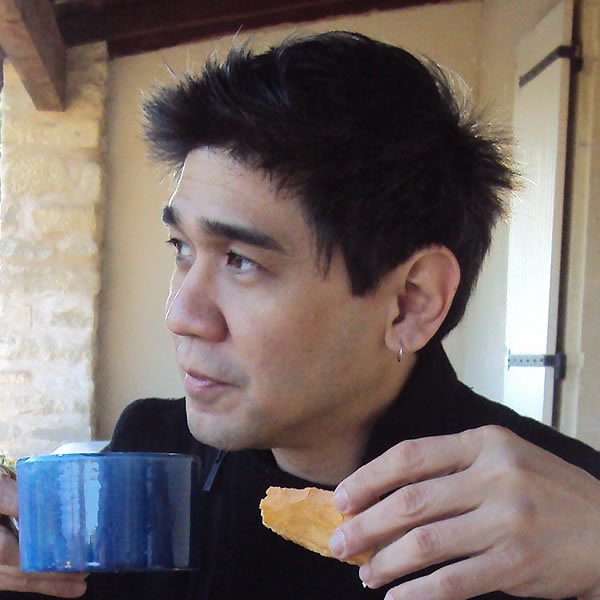
Joby finished his theology courses on doctrine, scripture, liturgy, and catechism from the satellite program of the University of Notre Dame. He is a contributing writer at theCatholicTalks.com, and catholic365.com where some of his articles have been translated into different languages for different websites around the world. He is passionate about suffrage for the souls in purgatory and maintains IndulgenceCooperative.org
He teaches multimedia arts at a prominent arts and design school where he engages students in conversations about religion, spirituality, pop-culture, and food.
Feel free to contact him if you want a talk in your organization.